



The Best U.S. Cities to Be a Blue Collar Worker


[lwptoc depth=”3″ hierarchical=”0″ numeration=”none” toggle=”0″ smoothScrollOffset=”120″ containerClass=”toc rightsec mt-0 pl-4 sticky sticky-right border-left d-block position-relative”]
Blue-collar workers keep America running by building homes, repairing power lines, maintaining vehicles, and producing the goods that shape everyday life. As automation, urban growth, and shifting labor markets continue to reshape the workforce, these hands-on roles remain the backbone of the U.S. economy.
In recognition of National Blue Collar Day, we analyzed national employment and wage data to uncover where blue-collar professionals are thriving most. The study evaluates major U.S. cities using factors such as wage competitiveness (including entry-level and top-earner pay), job density (jobs per 1,000 workers), employment concentration, cost of living, and entry-level earning potential, comparing outcomes across five key industries: construction and extraction; farming, fishing, and forestry; installation, maintenance and repair; production; and transportation and material moving.
Key Takeaways
- Riverside, California ranks as the best U.S. city for blue-collar workers overall, driven by strong employment opportunities in transportation and construction.
- The West Coast dominates the top 10, with California cities like Riverside, Stockton, and Bakersfield, as well as Spokane, Seattle, and Portland, all earning top spots for blue-collar labor market strength.
- Wichita, Kansas ranks No. 1 for production jobs, offering some of the most competitive manufacturing wages in the country.
- Tulsa, Oklahoma leads the nation for installation, maintenance, and repair workers, thanks to high job concentration and an affordable cost of living.
- New Orleans, Louisiana provides the strongest entry-level advantage, where blue-collar starters earn about 33% more than the citywide average.
The Best U.S. Cities Overall for Blue-Collar Workers
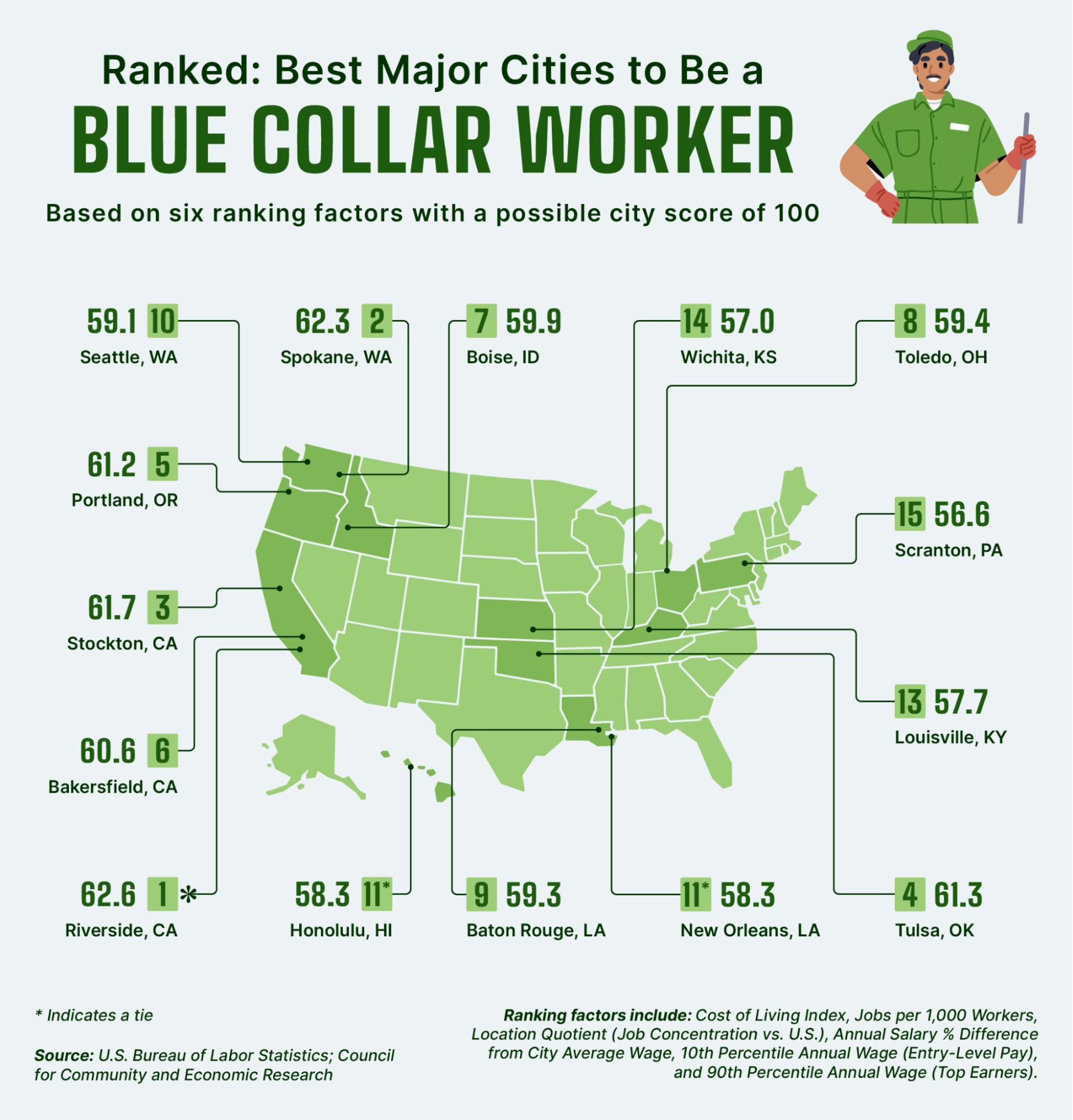
To find the best U.S. cities for blue-collar workers, we scored five major industries across six key factors, including cost of living, job density (jobs per 1,000 workers), employment concentration, and wage competitiveness. An average of each city’s performance across these metrics was used to pinpoint which cities offer the strongest economic conditions for blue-collar workers.
Top 10 U.S. Cities for Blue-Collar Workers
- Riverside, CA – 62.6 / 100
- Spokane, WA – 62.3 / 100
- Stockton, CA – 61.7 / 100
- Tulsa, OK – 61.3 / 100
- Portland, OR – 61.2 / 100
- Bakersfield, CA – 60.6 / 100
- Boise, ID – 59.9 / 100
- Toledo, OH – 59.4 / 100
- Baton Rouge, LA – 59.3 / 100
- Seattle, WA – 59.1 / 100
Riverside, California tops the national ranking with a score of 62.6 out of 100, supported by competitive wages and high job concentration across multiple industries — especially in transportation and construction, where top earners can reach six figures. While living costs are higher than the U.S. average, the city’s strong employment presence and access to well-paying trade roles make it one of the best places in the country for blue-collar workers to build long-term careers.
In second place, Spokane, Washington combines an affordable cost of living with balanced pay and solid employment concentration across blue-collar sectors. With top earners in installation, maintenance, and repair averaging close to $100,000 annually, the city offers reliable wage potential without the financial strain of larger metropolitan areas. Its smaller population of under 600k provides the benefits of a close-knit community while still supporting diverse trade opportunities.
Rounding out the top three, Stockton, California earned a 61.7 overall score thanks to extremely strong job concentration, particularly in farming and transportation, alongside competitive wages across multiple trades. With one of the highest blue-collar employment densities in the country and a metropolitan population nearing 790,000, the city offers abundant industry demand and income potential, helping it stand out even among larger, more expensive coastal cities.
Best Cities by Blue-Collar Industry
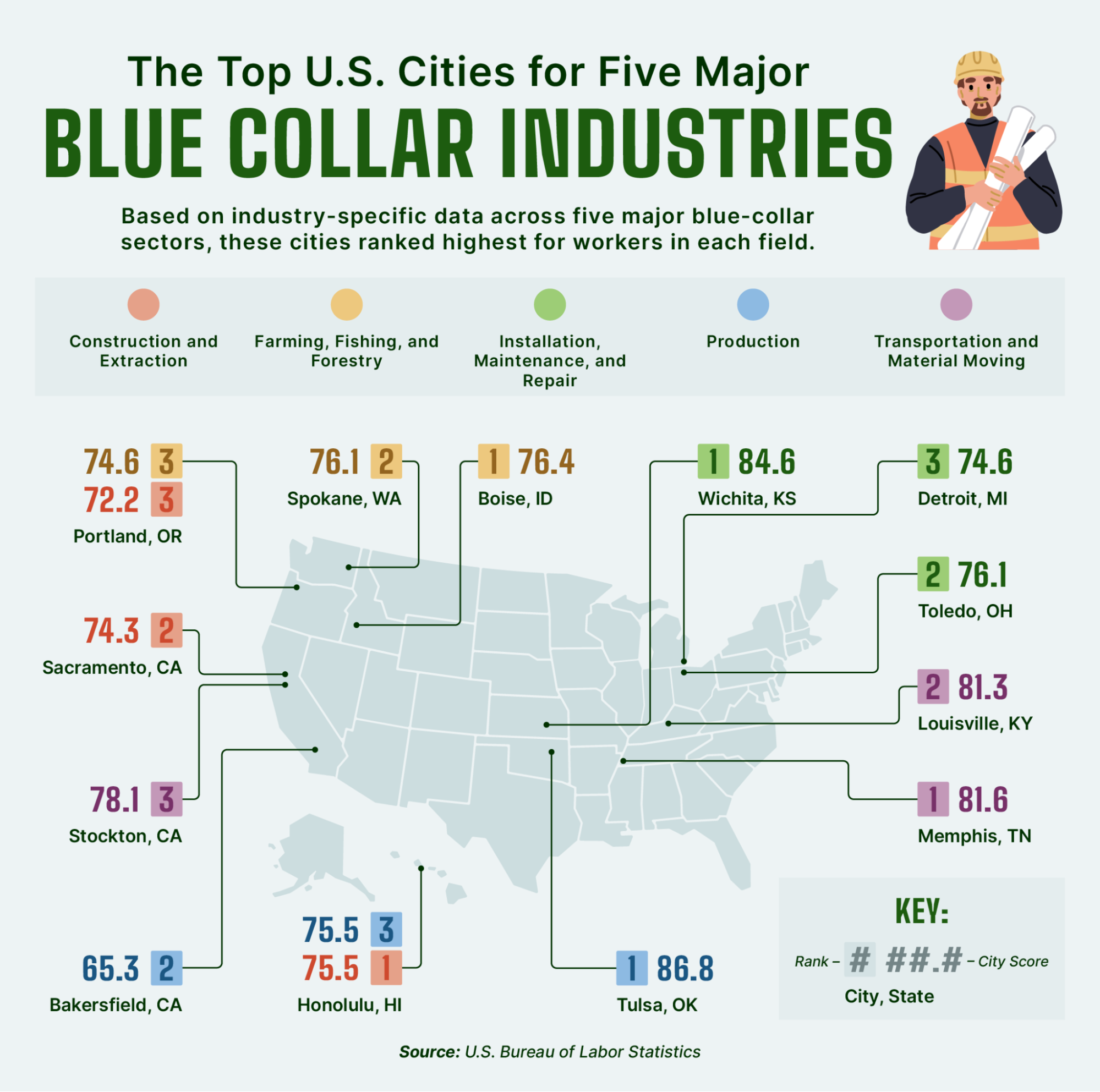
Blue-collar work spans a range of industries — from construction and production to maintenance, transportation, and agriculture. Below, BizInsure breaks down the top five U.S. cities in each major category based on factors such as job concentration, wages (from entry-level to top earners), and overall market strength.
Best Cities for Construction & Extraction Workers
Cities leading in construction and extraction offer high job concentration and wages that outperform the local average.
- Honolulu, HI – 75.5 / 100
- Sacramento, CA – 74.3 / 100
- Portland, OR – 72.2 / 100
- Riverside, CA – 71.7 / 100
- Seattle, WA – 68.2 / 100
Honolulu takes the top spot with strong wage competitiveness — including high earnings for both entry-level and experienced workers — paired with a solid employment concentration in the blue-collar sector. Sacramento and Portland follow closely, supported by elevated job density and pay levels that exceed average citywide wages.
Best Cities for Installation, Maintenance & Repair Workers
High industry concentration and strong earning potential make these cities the top destinations for maintenance and repair professionals.
- Tulsa, OK – 86.8 / 100
- Bakersfield, CA – 65.3 / 100
- Honolulu, HI – 64.0 / 100
- Syracuse, NY – 62.5 / 100
- Wichita, KS – 62.3 / 100
Tulsa leads the nation with a standout score of 86.8, supported by exceptionally high job concentration and competitive wages, all paired with a relatively accessible cost of living. Bakersfield and Honolulu also perform well thanks to strong top-earner wage potential in key repair trades.
Best Cities for Transportation & Material Moving Workers
Transportation and logistics roles thrive in cities with dense freight networks, strong job concentration, and competitive wages.
- Memphis, TN – 81.6 / 100
- Louisville, KY – 81.3 / 100
- Stockton, CA – 78.1 / 100
- Riverside, CA – 76.2 / 100
- Indianapolis, IN – 67.5 / 100
Memphis earns the No. 1 spot with some of the highest transportation job density and wage competitiveness in the country, while Louisville follows closely with similarly strong employment concentration. Stockton and Riverside rank highly due to their elevated job intensity and above-average earning potential in freight-related roles.
Best Cities for Production Workers
Manufacturing hubs excel where production roles are highly concentrated and both entry-level and senior workers earn competitively.
- Wichita, KS – 84.6 / 100
- Toledo, OH – 76.1 / 100
- Detroit, MI – 74.6 / 100
- Milwaukee, WI – 70.6 / 100
- Baton Rouge, LA – 70.5 / 100
Wichita tops the category with the highest score across any industry, reflecting its status as a major manufacturing center with high job density and strong earning potential across wage tiers. Toledo and Detroit remain production strongholds, while Baton Rouge stands out in the South for its competitive industrial wage landscape.
Best Cities for Farming, Fishing & Forestry Workers
Agricultural and resource-based work flourishes where job concentration is high and earnings remain strong relative to local wage averages.
- Boise, ID – 76.4 / 100
- Spokane, WA – 76.1 / 100
- Portland, OR – 74.6 / 100
- Sacramento, CA – 72.8 / 100
- Riverside, CA – 70.3 / 100
Boise takes the top spot for the strongest job concentration and wage performance in the farming and forestry sector. Spokane and Portland rank closely behind thanks to solid location quotients and stable earning potential supported by regional agricultural networks.
Best Cities for Entry-Level Blue-Collar Workers
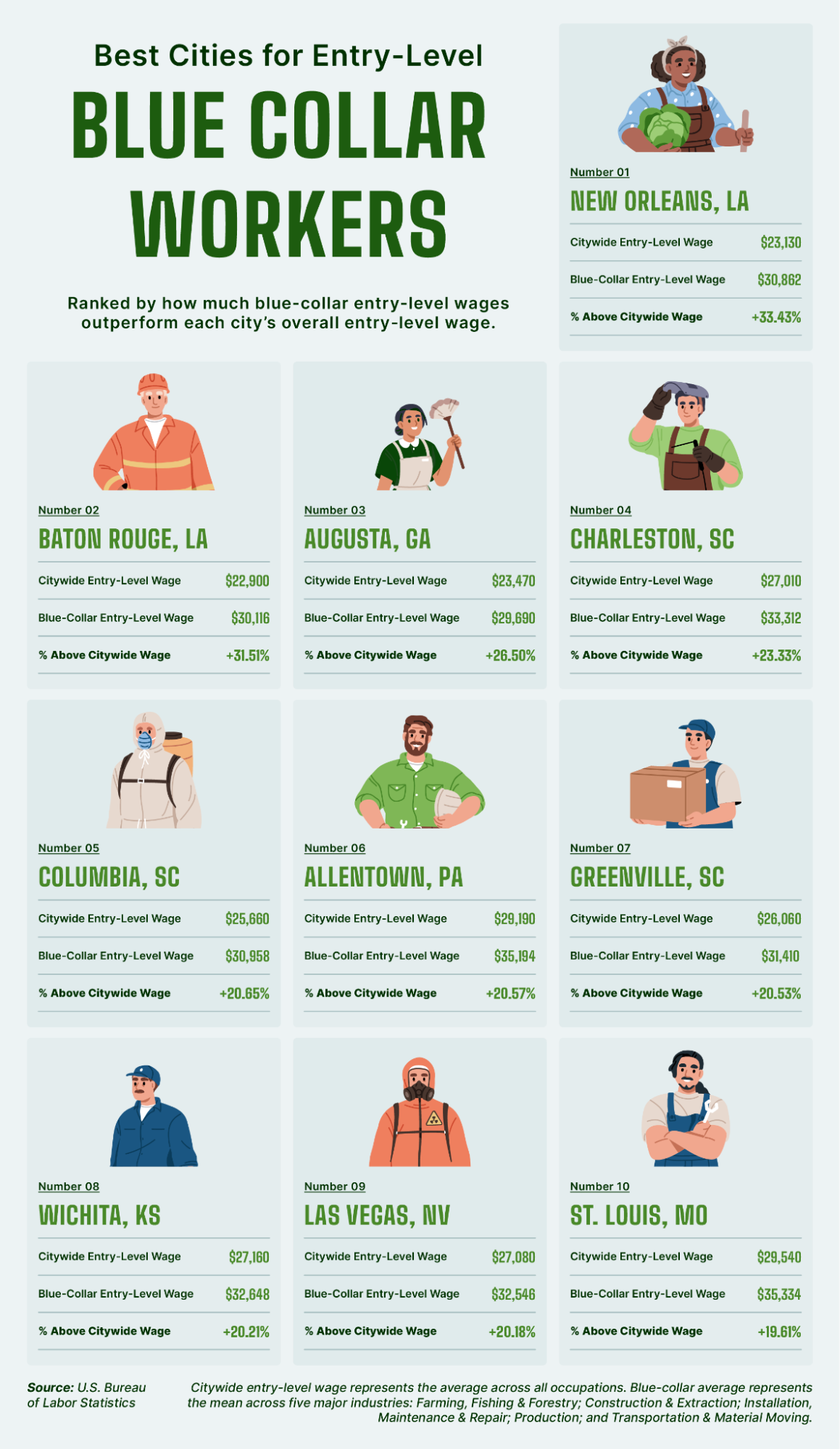
To find where new blue-collar workers get the best start, BizInsure compared entry-level wages in blue-collar industries to each city’s average entry-level salary. The resulting “entry-level advantage” shows where beginners in hands-on trades earn more than the average starter across all occupations.
Top 10 Cities for Entry-Level Blue-Collar Workers
| Rank | City | Citywide Entry-Level Wage | Blue-Collar Entry-Level Wage | % Above/Below Citywide Wage |
| 1 | New Orleans, LA | $23,130 | $30,862 | +33.43% |
| 2 | Baton Rouge, LA | $22,900 | $30,116 | +31.51% |
| 3 | Augusta, GA | $23,470 | $29,690 | +26.50% |
| 4 | Charleston, SC | $27,010 | $33,312 | +23.33% |
| 5 | Columbia, SC | $25,660 | $30,958 | +20.65% |
| 6 | Allentown, PA | $29,190 | $35,194 | +20.57% |
| 7 | Greenville, SC | $26,060 | $31,410 | +20.53% |
| 8 | Wichita, KS | $27,160 | $32,648 | +20.21% |
| 9 | Las Vegas, NV | $27,080 | $32,546 | +20.18% |
| 10 | St. Louis, MO | $29,540 | $35,334 | +19.61% |
New Orleans offers the strongest entry-level advantage in the nation, where blue-collar starters earn 33% more than the average beginner wage in the city. Close behind, Baton Rouge workers enjoy a 31% premium, reflecting how early-career tradespeople earn significantly more than other entry-level employees in the region.
Cities across the South — including Augusta, Charleston, Columbia, and Greenville — all make the top ten, highlighting the region’s strong wage positioning for new blue-collar entrants. Competitive early earnings alongside moderate living costs make these cities appealing starting points for workers entering skilled trades.
While Southern cities lead the way, metro areas like Allentown, Pennsylvania; Wichita, Kansas; and Las Vegas, Nevada, also stand out for their above-average entry-level wage advantages. Across the board, these cities demonstrate how blue-collar roles can deliver strong earning power early in a trade career.
Closing Thoughts
A new generation of blue-collar hubs is emerging across the country — offering workers stronger wage potential, high job concentrations, and opportunities to advance in skilled trades. From Riverside and Spokane to New Orleans and Wichita, these cities are proving that hands-on careers remain a vital and resilient force in the nation’s economy.
For many workers, choosing the right city can significantly influence early earning potential, access to trade opportunities, and long-term career outlook. In the right environment, blue-collar professionals can build stable, rewarding futures for themselves and their families.
Protecting your business is just as important as running it. BizInsure helps skilled workers do that by providing a fast, reliable way to compare quotes and get the right insurance for their business in minutes. It’s insurance built for the contractors and tradies who keep America running — designed to save time and give peace of mind.
As blue-collar industries continue to evolve, cities that offer competitive wages and strong employment concentration will remain prime destinations for trade professionals — especially when paired with smart financial planning and business protection.
Methodology
We defined blue-collar jobs as occupations under SOC major groups 45, 47, 49, 51, and 53 (Farming, Construction, Installation, Production, and Transportation), as classified by the U.S. Bureau of Labor Statistics.
To find the best cities for blue-collar workers, we analyzed five industries: Farming, Fishing, and Forestry; Construction and Extraction; Installation, Maintenance, and Repair; Production; and Transportation and Material Moving. Each city was scored in each industry using six factors: Cost of Living Index, Jobs per 1,000 Workers, Location Quotient (job concentration vs. U.S.), Annual Salary % Difference from City Average Wage, 10th Percentile Annual Wage (entry-level pay), and 90th Percentile Annual Wage (top earners). Scores were then averaged across all five industries to determine each city’s overall ranking, with industry-specific rankings also reported separately.
To identify the best cities for entry-level blue-collar workers, we compared the average 10th percentile wage across the five industries to each city’s overall 10th percentile wage across all occupations. The resulting percentage difference reflects how much more (or less) entry-level blue-collar workers earn compared to the typical entry-level worker in that city.
All data was sourced from the U.S. Bureau of Labor Statistics Occupational Employment and Wage Statistics (May 2023) and the Council for Community and Economic Research Cost of Living Index (2023 Annual Average).
Fair Use
You are welcome to use, reference, and share non-commercial excerpts of this study with proper attribution. If you cite or cover our findings, please link back to this page so readers can view the full methodology, charts, and context.
© Copyright 2025 BizInsure LLC, 2015 ALL RIGHTS RESERVED BizInsure LLC; CA DBA: Simple, Smart, BizInsure Insurance Agency LLC; NY DBA: BizInsure Services LLC; NH DBA: Simple, Smart, BizInsure Insurance Agency; PA DBA: BizInsure Services LLC. 2950 Buskirk Ave Suite 300, Walnut Creek CA 94597. License #0H81929.